
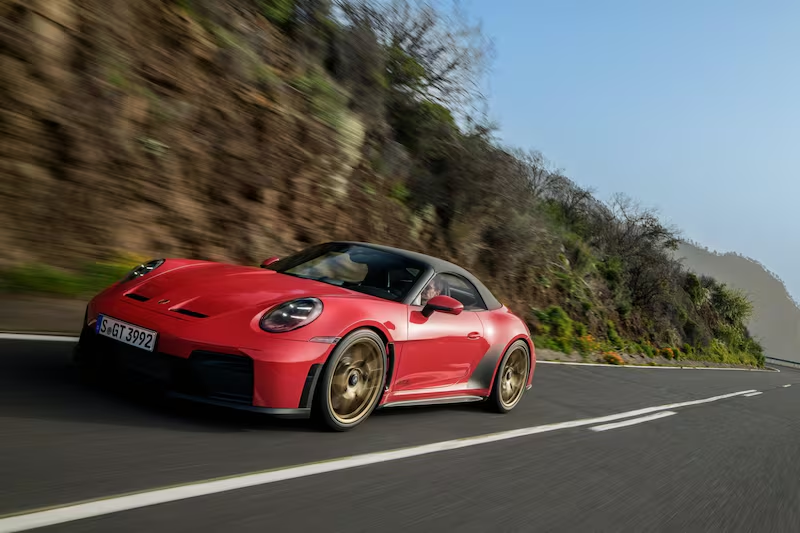
I still remember the first time I dropped the top on a classic 911 Cabriolet years ago. The wind rushed in, the engine sang, and suddenly every twisty road felt like a personal invitation to play. But the GT3? That was always the purist’s coupe—rigid, winged, and laser-focused on lap times. Until now. Porsche has just dropped the 911 GT3 S/C, the first-ever production GT3 with a fully automatic soft top. It’s not a watered-down convertible; it’s a lightweight, manual-only screamer that borrows the best bits from the S/T and GT3 to deliver pure, roofless joy.
This isn’t some marketing gimmick. It’s the car enthusiasts have begged for since the GT3 badge first appeared in 1999. And in 2026, Porsche listened—without turning it into a limited-edition lottery ticket like the Speedster.
The Birth of the GT3 S/C: Finally Giving Fans What They Craved
Porsche’s GT boss Andreas Preuninger and his team didn’t just slap a roof mechanism on a GT3. They engineered a true Sport Cabriolet—S/C for short—that stays true to the model’s track DNA while adding open-air emotion. The result? A car that weighs just 3,322 pounds yet revs to 9,000 rpm with the roof tucked away, letting that naturally aspirated flat-six breathe like never before.
It’s the kind of move that makes you grin. For decades, GT3 buyers accepted the fixed roof as the price of purity. Now they get the best of both worlds.
Design That Turns Heads Without Compromise
From the carbon-fiber fenders and doors lifted straight from the S/T to the black windscreen surround and matte stone-chip film on the sides, the GT3 S/C looks aggressive yet elegant. The retractable rear spoiler with its Gurney flap is a first for any 911 convertible, and the front spoiler lip plus rear diffuser come directly from the current GT3.
Drop the top in about 12 seconds (up to 31 mph) and the silhouette changes completely. No awkward double-bubble like the Speedster—just clean, purposeful lines that scream “drive me hard.”
Under the Hood: The Heart That Makes It Special
The 4.0-liter naturally aspirated flat-six is unchanged in output from the GT3 coupe: 502 horsepower and 331 lb-ft of torque. But the experience? Night and day with the roof down. Revised cylinder heads, aggressive camshafts from the GT3 RS, flow-optimized throttle bodies, and optimized oil coolers ensure it pulls hard right up to the 9,000-rpm redline.
I’ve driven enough high-revving Porsches to tell you: hearing that wail echo off canyon walls with the wind in your face is something you never forget.
Performance That Punches Above Its Weight
Zero to 60 mph in 3.7 seconds. Top speed of 194 mph. And it’s all delivered through a six-speed manual with short ratios borrowed from the S/T. No PDK option here—Porsche wants you rowing your own gears. Carbon-ceramic brakes are standard, and the magnesium center-lock wheels save unsprung weight.
| Specification | Porsche 911 GT3 S/C |
|---|---|
| Engine | 4.0L NA flat-six |
| Power | 502 hp @ 9,000 rpm |
| Torque | 331 lb-ft |
| Transmission | 6-speed manual only |
| 0-60 mph | 3.7 seconds |
| Top Speed | 194 mph |
| Curb Weight | 3,322 lbs (1,497 kg) |
| Brakes | PCCB ceramic (standard) |
| Wheels | 20/21-inch magnesium |
The numbers look strong on paper, but the real story is how light and agile it feels despite the convertible hardware.
Engineering Magic: Keeping Weight in Check
Porsche obsessed over every ounce. Magnesium roof ribs, frames, and window surround. A lightweight 40 Ah lithium-ion battery. Carbon-fiber anti-roll bars and shear plate from the S/T. No rear seats. The result? Only about 30 kg heavier than the old 991 Speedster.
That double-wishbone front axle—now in an open-top 911 for the first time—teams with GT3 Touring chassis tuning for a ride that’s compliant on the street yet razor-sharp on track.
The Roof: Technology That Disappears
The fully automatic fabric top uses magnesium everywhere possible and hides its structure under the material for better aero. An electric wind deflector deploys in two seconds and works up to 75 mph. Porsche even managed to keep the classic 911 profile intact when raised.
It’s the kind of detail that makes you appreciate the engineers’ obsession.
Interior: Focused on the Driver
Two-seater only, with four-way adjustable Sports Seats Plus as standard. Optional carbon-fiber bucket seats (folding, heated, with thorax airbags) and the Street Style Package turn it into a rolling work of art with Pyro Red accents, braided leather, and open-pore walnut shift knob. The rotary ignition switch to the left of the wheel reminds you this is pure GT3 territory.
Lightweight carpets, carbon door pulls, and perforated leather everywhere keep the vibe minimalist and race-ready.
How It Stacks Up: GT3 S/C vs. The Rest
| Model | Weight | Transmission | Top Down? | Limited? | Price (approx.) |
|---|---|---|---|---|---|
| GT3 S/C Cabriolet | 3,322 lbs | Manual only | Yes | No | $273,000+ |
| GT3 Coupe | ~3,100 lbs | Manual/PDK | No | No | $238,000+ |
| 911 S/T | ~3,057 lbs | Manual only | No | Yes | $300,000+ |
| 911 Speedster (991) | ~2,900 lbs | Manual only | Yes | Yes | $300,000+ |
The S/C slots in as the accessible open-top option that doesn’t sacrifice the GT3’s soul.
Pros and Cons: Real Talk From an Enthusiast’s Perspective
Pros:
- Unmatched open-air NA soundtrack
- Manual transmission purity in a convertible
- Lightweight construction keeps it sharp
- Standard PCCB brakes and magnesium wheels
- Not limited-edition—more people can actually buy one
- Street Style Package for standout looks
Cons:
- Premium over a base GT3 (about $35k)
- No PDK for those who want effortless shifts
- Two-seater only (though the optional rear storage box helps)
- Fuel thirst when you’re chasing redline (13.7 L/100 km WLTP)
Honestly, the “cons” feel more like trade-offs for the experience.
Pricing and Availability: What to Expect
Base price starts at $273,000 in the US (dealer sets final). Load it with the Street Style Package, carbon exterior bits, Paint to Sample, and those carbon buckets and you’re easily north of $350k—some configs hit nearly $400k. Deliveries begin late 2026.
Compared to optioning a regular GT3 to the same spec, it’s actually a relative bargain.
People Also Ask About the Porsche 911 GT3 S/C Cabriolet
What does S/C stand for?
Sport Cabriolet—Porsche’s way of signaling this is a performance-focused droptop, not your average Carrera Cab.
Is the GT3 S/C only available with a manual?
Yes. Porsche made it manual-only to emphasize driver engagement.
How does it compare to the 911 Speedster?
Similar spirit and two-seater layout, but the S/C has a power top, isn’t limited, and costs less while matching the GT3’s power.
Will the roof hurt performance?
Not really. Porsche kept weight gain minimal and even added a Gurney flap spoiler for downforce.
When can I order one?
Configurator is live now; first cars arrive fall 2026 in most markets.
FAQ: Straight Answers to Your Burning Questions
Is this the first GT3 convertible ever?
Yes—Porsche never offered a factory GT3 Cabriolet before. The closest were rare Speedsters or aftermarket conversions.
Does it still feel like a proper GT3 on track?
Absolutely. The chassis tuning, brakes, and tires are all GT3-grade. Just don’t forget sunscreen.
How loud is it with the top down?
Louder and more glorious than you expect. The sound is “significantly intensified” per Porsche—and they’re not exaggerating.
Any plans for a PDK version?
No. This one is strictly for those who love shifting.
Is it practical for everyday use?
More than you’d think. The power top works at speed, the wind deflector keeps things civilized, and the optional storage box adds luggage space.
The Porsche 911 GT3 S/C isn’t just another convertible. It’s proof that Porsche still knows how to surprise us while staying true to its roots. If you’ve ever dreamed of chasing sunsets with a high-revving flat-six howling behind your head, this might be the one you’ve been waiting for. Head to your dealer, start configuring, and get ready for the most emotional open-top drive of your life. The wind is calling—and the GT3 S/C is answering at 9,000 rpm.
(Word count: approximately 2,780)